10 financial models for commercial real estate analysis, and what each one answers
For CRE analysts, investors and lenders: the models behind acquisition, development, financing and portfolio decisions, what each calculates, and where the input data comes from.

Key takeaways
- CRE analysis uses a small set of model types: acquisition cash flow (DCF), development pro forma, lease-by-lease, debt sizing, value-add, refinance, waterfall, sensitivity, hold-sell and portfolio models.
- Almost every model starts from net operating income (NOI), built from the T12 operating statement and the rent roll.
- The core ratios are cap rate (NOI ÷ value), DSCR (NOI ÷ debt service), debt yield (NOI ÷ loan), cash-on-cash return, IRR and equity multiple.
- In the worked example, a property with $930,000 NOI bought at $15.5 million is a 6.0% cap rate; a 65% loan at 6.5% gives a 1.22x DSCR and a 9.2% debt yield.
- The slowest part of modeling is getting the inputs in: extracting T12s, rent rolls and OMs into the model is where automation saves time.
On this page
Commercial real estate financial modeling relies on about 10 models: acquisition cash flow (DCF), development pro forma, lease-by-lease, debt sizing, value-add, refinance, equity waterfall, sensitivity, hold-sell and portfolio models. Each answers a different investment or lending question, but almost all start from net operating income (NOI), built from the T12 operating statement and the rent roll, and use the same ratios: cap rate, DSCR, debt yield, cash-on-cash return, IRR and equity multiple.
This guide covers the core formulas with a worked example, what each model answers, and where the input data comes from. Most of these models live in Excel spreadsheets or ARGUS; the math is the same either way.
The core CRE formulas#
| Metric | Formula | What it tells you |
|---|---|---|
| Net operating income (NOI) | Effective gross income − operating expenses | The property's income before financing and capital costs |
| Cap rate | NOI ÷ value (or price) | Unlevered yield; used to value property |
| Debt service coverage ratio (DSCR) | NOI ÷ annual debt service | Whether income covers the loan payments |
| Debt yield | NOI ÷ loan amount | Lender's return if it took the property |
| Loan-to-value (LTV) | Loan ÷ value | Leverage |
| Cash-on-cash return | Annual cash flow after debt service ÷ equity invested | Levered cash yield |
| IRR | Discount rate at which the net present value of all cash flows is zero | Time-weighted return over the hold |
| Equity multiple | Total cash returned ÷ equity invested | Total return, ignoring timing |
The NOI, cap rate, DSCR and debt yield definitions follow the glossary in the OCC's Comptroller's Handbook on commercial real estate lending, which also lists DSCR, debt yield and LTV among the most common loan covenants.
Worked example#
A multifamily property with NOI of $930,000 (see the T12 example), bought for $15,500,000 with a 65% loan at 6.5% interest, amortized over 30 years:
- Cap rate: $930,000 ÷ $15,500,000 = 6.0%
- Loan: 65% × $15,500,000 = $10,075,000
- Annual debt service: about $764,000 ($63,681 a month)
- DSCR: $930,000 ÷ $764,000 = 1.22x
- Debt yield: $930,000 ÷ $10,075,000 = 9.2%
- Equity: $5,425,000 (before closing costs)
- Cash-on-cash: ($930,000 − $764,000) ÷ $5,425,000 = 3.1%
Because the loan rate (6.5%) is above the cap rate (6.0%), leverage lowers the cash yield here. The deal only works if NOI grows or the exit value rises, which is what the models below test.
10 financial models for commercial real estate#
Pick the model by the question you need answered. Each builds on the same NOI.
Acquisition cash flow (DCF)
Should we buy? Projects income, expenses, capital costs, debt and sale proceeds over a 5 to 10 year hold to get IRR, equity multiple and yearly cash-on-cash.Development pro forma
Is the yield on cost worth the risk? Models land, hard and soft costs, construction draws, lease-up and stabilized value.Lease-by-lease
What will each tenant pay? For office, retail and industrial: rents, escalations, recoveries, renewals, downtime and leasing costs, built from the rent roll and leases.Debt sizing
How much can we lend? The lender's model: the largest loan that meets DSCR, debt yield and LTV limits, taking the lowest, on the lender's underwritten NOI. See CRE underwriting.Value-add
Does the business plan pay off? Adds renovation costs, rent premiums, downtime and lease-up to an acquisition model.Refinance
Can the property refinance at maturity? Tests the new loan size, rate and proceeds at a future date.Equity waterfall
Who gets what? Splits cash flow and profit between sponsor and investors through preferred return, return of capital and promote tiers.Sensitivity and scenario
What if we're wrong? Shows how returns move with rent growth, vacancy, exit cap rate, interest rate and capital costs.Hold-sell
Sell now or keep? Compares the return from selling today with holding, given the NOI path, capital needs and market cap rates.Portfolio
Where is the risk concentrated? Rolls up property models into portfolio NOI, leverage, debt maturities, covenant headroom and concentration.
Where the inputs come from#
| Input | Source documents |
|---|---|
| In-place rents, occupancy, lease terms | Rent roll, leases |
| Historical income and expenses | T12 operating statement, operating statements for prior years |
| Seller's pro forma and property details | Offering memorandum |
| Taxes and insurance | Tax bills, insurance quotes and certificates |
| Borrower strength (for lenders) | Financial statements, tax returns, schedule of real estate owned |
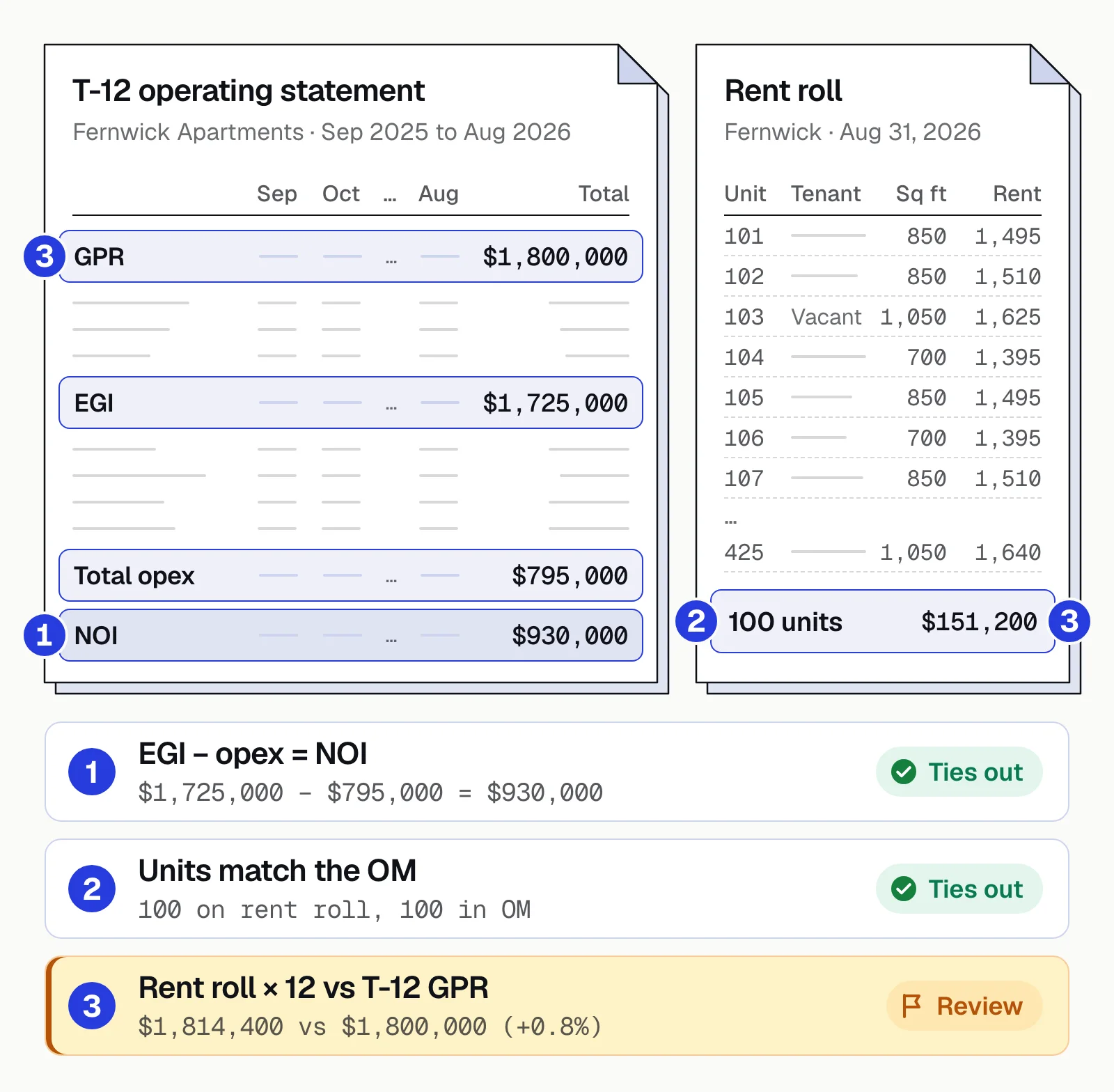
Getting these into the model is the slow part: every property manager formats T12s and rent rolls differently, and the two have to tie out before anyone trusts the NOI.
Docsumo extracts T12s, rent rolls and financial statements (99% field-level accuracy across 250+ document types) and sends values it's unsure about to a reviewer. The data goes to your model as an Excel export or through API and webhooks; the model itself stays yours. See extracting data from T12s and rent rolls and financial spreading.
Tips for building reliable CRE models#
- Separate inputs, calculations and outputsKeep them on different tabs so every assumption sits in one place.
- Underwrite from the T12 and rent rollNot the OM's pro forma, and document every adjustment.
- Tie out to the sourceRent roll income against T12 rental income, and model NOI against the T12.
- Stress the exit cap rate and interest rateThey're the two assumptions that move returns most.
- Version the modelLog assumption changes for committee review.
The bottom line#
Most CRE decisions come down to a handful of models built on the same foundation: NOI from the T12 and rent roll, and the ratios that turn it into value, loan size and returns. Pick the model that answers your question, get the inputs right and test the downside. For tools that automate the input side, see the best CRE underwriting software.
Book a demo with a T12 and rent roll of your own, or start a free trial.
Frequently asked questions#
What financial model is used in commercial real estate?
The most common is an acquisition cash flow model, or DCF, that projects NOI, capital costs, debt and sale proceeds over a hold period to calculate IRR and equity multiple. Lenders add debt sizing models built around DSCR, debt yield and loan-to-value.
What inputs does a CRE financial model need?
The rent roll (units or tenants, rents, lease dates), the T12 operating statement (income and expenses), purchase price and closing costs, capital plan, financing terms, growth assumptions and an exit cap rate.
What is a good DSCR for commercial real estate?
There's no single number. Lenders set minimum DSCRs by property type, loan program and risk, and state them in their term sheets. Higher coverage means more room for NOI to fall before payments are at risk.
What is the difference between cap rate and cash-on-cash return?
Cap rate is NOI divided by property value and ignores financing. Cash-on-cash return is annual cash flow after debt service divided by the equity invested, so it reflects leverage.
How do you build a commercial real estate valuation spreadsheet?
Put inputs (rent roll, T12, price, loan terms, growth and exit assumptions) on one tab, build NOI from them on a second, and calculate value, debt metrics and returns on a third. Value the property by dividing NOI by a market cap rate, then check the result against a DCF of the hold period.
Can CRE models be automated?
The calculations are already automated in Excel or ARGUS. What takes time is entering the inputs. Document extraction reads T12s, rent rolls and OMs and exports the values for the model. See CRE underwriting automation.
Sources
First published . Last updated .