Lease abstraction: what it is, the process and how to automate lease data extraction
For commercial real estate lenders, owners, asset managers and lease accountants: what a lease abstract contains, how the process works, where it goes wrong and how to automate it.


Key takeaways
- Lease abstraction is reading a lease and capturing its key terms (parties, dates, rent, escalations, options and obligations) in a short, structured summary called a lease abstract.
- Lenders use abstracts to underwrite property loans, owners and asset managers to track critical dates and cash flow, and accountants for lease accounting under ASC 842.
- The hard part isn't the base rent. It's the clauses that change the economics: escalations, free rent, recoveries, renewal and termination options, co-tenancy and exclusives.
- Every value should cite its source clause and page, and amendments must be applied in date order.
- Lease data extraction software drafts the abstract in minutes; a reviewer confirms the critical fields, especially where an amendment overrides the original lease.
On this page
Lease abstraction is the process of reading a lease and capturing its key terms, such as the parties, dates, rent, escalations, options and each side's obligations, in a short structured summary called a lease abstract. CRE lenders, owners, asset managers and lease accountants rely on abstracts because a 60-page lease with three amendments is too long to reread every time someone needs the rent schedule or a renewal deadline.
What is a lease abstract?#
A lease abstract condenses a lease into the terms that drive value and risk, usually as structured fields in a lease administration, accounting or loan system. What matters most depends on who reads it:
Who needs the abstract?
What to capture in a lease abstract#
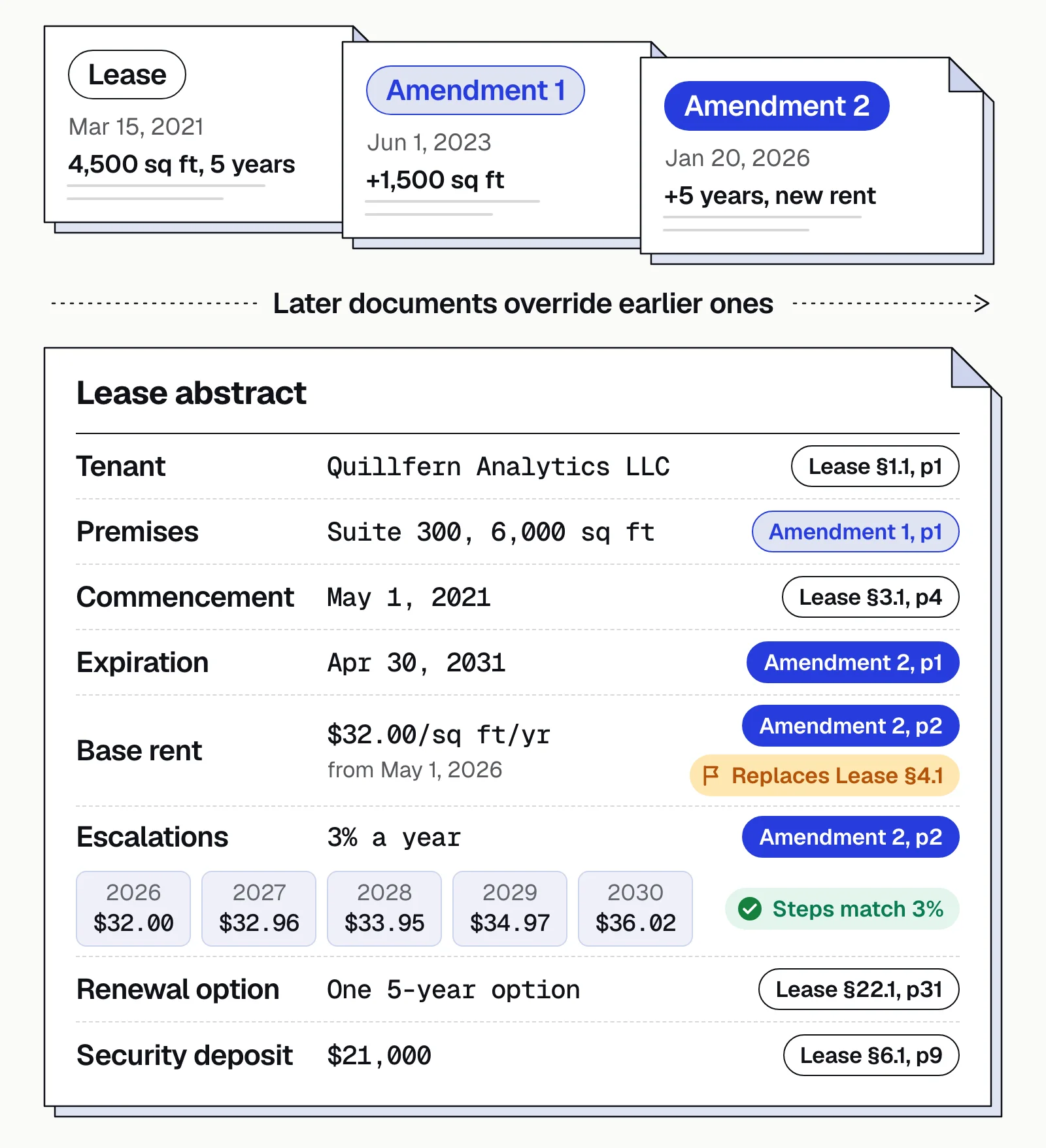
Each field cites the clause and page it came from:
| Category | Fields |
|---|---|
| Parties | Landlord, tenant (legal entity), guarantor, notice addresses |
| Premises | Address, suite, rentable and usable square footage, parking |
| Key dates | Execution, commencement, rent commencement, expiration, notice deadlines |
| Rent | Base rent schedule, escalations (fixed, percentage or CPI), free rent, late fees |
| Additional rent | Expense and tax recoveries, base year or expense stop, CAM |
| Security | Security deposit, letter of credit, guaranty |
| Options | Renewal, expansion, termination, first refusal, purchase |
| Use and restrictions | Permitted use, exclusives, co-tenancy, radius restrictions, operating covenants |
| Transfers | Assignment and subletting rights, change of control |
| Maintenance and insurance | Repair duties, insurance requirements, liability and indemnities |
| Amendments | Each amendment's date and the terms it changes |
The lease abstraction process#
- Collect the full lease fileThe lease plus every amendment, side letter, commencement memo, assignment and sublease.
- Order the documents by dateLater documents override earlier ones.
- Extract the termsFill in your template, noting the clause and page for each value.
- Apply the amendmentsProduce the current terms and keep the history.
- Calculate derived valuesThe rent schedule and critical dates, such as the last day to exercise a renewal option.
- ReviewCheck the abstract against the source, with a second reviewer for high-value leases.
- Load the dataCentralize every lease's terms in one lease, accounting or loan system, with alerts for critical dates.
Common lease abstraction mistakes#
- Every amendment appliedA missing amendment is the most common cause of a wrong rent, term or square footage.
- Escalations read exactly"3% annually" and "3% over the prior year's rent including recoveries" give different numbers.
- The right commencement dateLease commencement, rent commencement and occupancy can all differ.
- Options capturedA tenant termination right can change a lender's view of the property.
- Every value citedWithout clause and page references, every question means rereading the lease.
Then check the abstracts against the rent roll and operating statement: a gap in rent, square footage or expiration dates usually means a missing amendment or a keying error.
How to automate lease abstraction with lease data extraction#
Leases are long, worded differently and spread across several documents. Lease data extraction software drafts the abstract; people confirm the terms that matter.
- Lease
- Amendments
- Rent roll
- 01Classify and order by date
- 02Extract clauses and values
- 03Apply amendments
- 04Check against the rent roll
- 05Review
Docsumo's lease abstraction software handles any document type, so leases, amendments and subleases need no lease-specific template: OCR reads the page, handwritten riders included, and language models structure it. Unsure fields go to your own reviewer, with the source line highlighted. For property loans, CRE underwriting checks each lease against the rent roll on the Enterprise plan. Results reach your systems through an API and webhooks. Docsumo is software, not an outsourced abstraction service.
Here's a lease abstracted that way:
| Field | Extracted value | Source |
|---|---|---|
| Landlord | Lakeview Commerce Center LLC | § 1.1 · p. 1 |
| Tenant | Cobalt Ridge, Inc. | § 1.2 · p. 1 |
| Premises | Suite 300, 3rd floor | § 1.3 · p. 1 |
| Rentable area | 6,000 RSF | § 1.3 · p. 1 |
| Tenant's share | 12.50% of 48,000 RSF | § 1.4 · p. 1 |
| Permitted use | General office | § 1.5 · p. 1 |
Related reading: rent roll automation and trailing 12 months in real estate.
The bottom line#
A lease abstract is only as good as the file behind it and the care taken with amendments and options. Standardize the template, cite every value, reconcile against the rent roll, and let software draft the abstract so people spend their time on the terms that matter.
Book a demo with a few of your own leases, or start a free trial.
Frequently asked questions#
What is a lease abstract?
A short summary of a lease's key terms, usually 2 to 5 pages or a set of structured fields, that shows the lease's economics and obligations without reading the full document.
What should be included in a lease abstract?
Parties, premises and square footage, key dates, base rent and escalations, free rent, security deposit, recoveries, renewal and termination options, assignment and subletting, use clauses, maintenance and insurance obligations, and every amendment.
What is lease data extraction?
Pulling the terms out of leases, amendments, assignments and subleases into structured fields, usually with software. It's the automated first step of lease abstraction.
Can AI do lease abstraction?
AI can find the clauses and draft the abstract in minutes, where a complex lease with amendments takes hours by hand. Because wording varies and amendments change earlier terms, a person should confirm the critical fields against their source.
What are lease abstraction services?
Outsourced teams that read your leases and fill in your abstract template, usually priced per lease. Software is the alternative: it drafts the abstract and your own team reviews it. Docsumo is software, not an abstraction service.
Why does lease abstraction matter for ASC 842?
Under ASC 842, lessees recognize a right-of-use asset and a lease liability for most leases. Measuring them takes accurate payments, escalations, terms and options, which is exactly what an abstract captures.
Sources
- Crowe: New lease accounting standard, right-of-use (ROU) assets
- EisnerAmper: How to adopt ASC 842 for private companies
First published . Last updated .