The best CRE underwriting software in 2026: 10 tools compared
Commercial real estate underwriting tools now split three ways: platforms that model the deal, platforms built for lenders, and tools that pull the numbers out of OMs, T-12s and rent rolls. Here's which does what, and how to pick.

Key takeaways
- CRE underwriting software turns a deal's documents (the offering memorandum, T-12 operating statement and rent roll) into a cash-flow model, a value and a decision.
- The tools fall into three groups: deal modeling and valuation (Cactus, PropRise Primer, Archer, U-Rite, ARGUS Enterprise), CRE lending platforms (Blooma, Clik.ai, Smart Capital Center) and document extraction that feeds your own model or loan system (Docsumo).
- The 2026 differentiator is traceability: every number in the model should link back to the page it came from.
- Most vendors don't publish prices. Of the ten here, only Smart Capital Center and U-Rite list prices on their sites.
- Test any tool on your messiest rent rolls and T-12s. Clean sample deals hide the problems.
On this page
- What CRE underwriting software does
- The three kinds of CRE underwriting software
- The 10 best CRE underwriting software tools
- CRE underwriting software compared
- How to choose CRE underwriting software
- Checks to run on extracted T-12s and rent rolls
- CRE due diligence for lenders
- The bottom line
- Frequently asked questions
CRE underwriting software, or commercial real estate underwriting software, turns a property's documents into a decision. It reads the offering memorandum (OM), the trailing-12 operating statement (T-12) and the rent roll, builds the cash flow, and works out value, returns or debt metrics. In 2026 the market has split into three groups: tools that model the deal, platforms built for CRE lenders, and tools that extract the numbers from the documents so any model can use them.
Vendor details below come from each vendor's own website, checked in September 2026. Links are in the sources at the end.
Which team are you?
What CRE underwriting software does#
Every CRE underwriting workflow moves the same way: documents in, numbers normalized, a model built, a decision made. The tools differ in which of these stages they own.
- Offering memorandum
- T-12 operating statement
- Rent roll
- Leases
- 01Extract the numbers
- 02Normalize line items
- 03Model cash flow and value
- 04Review and decide
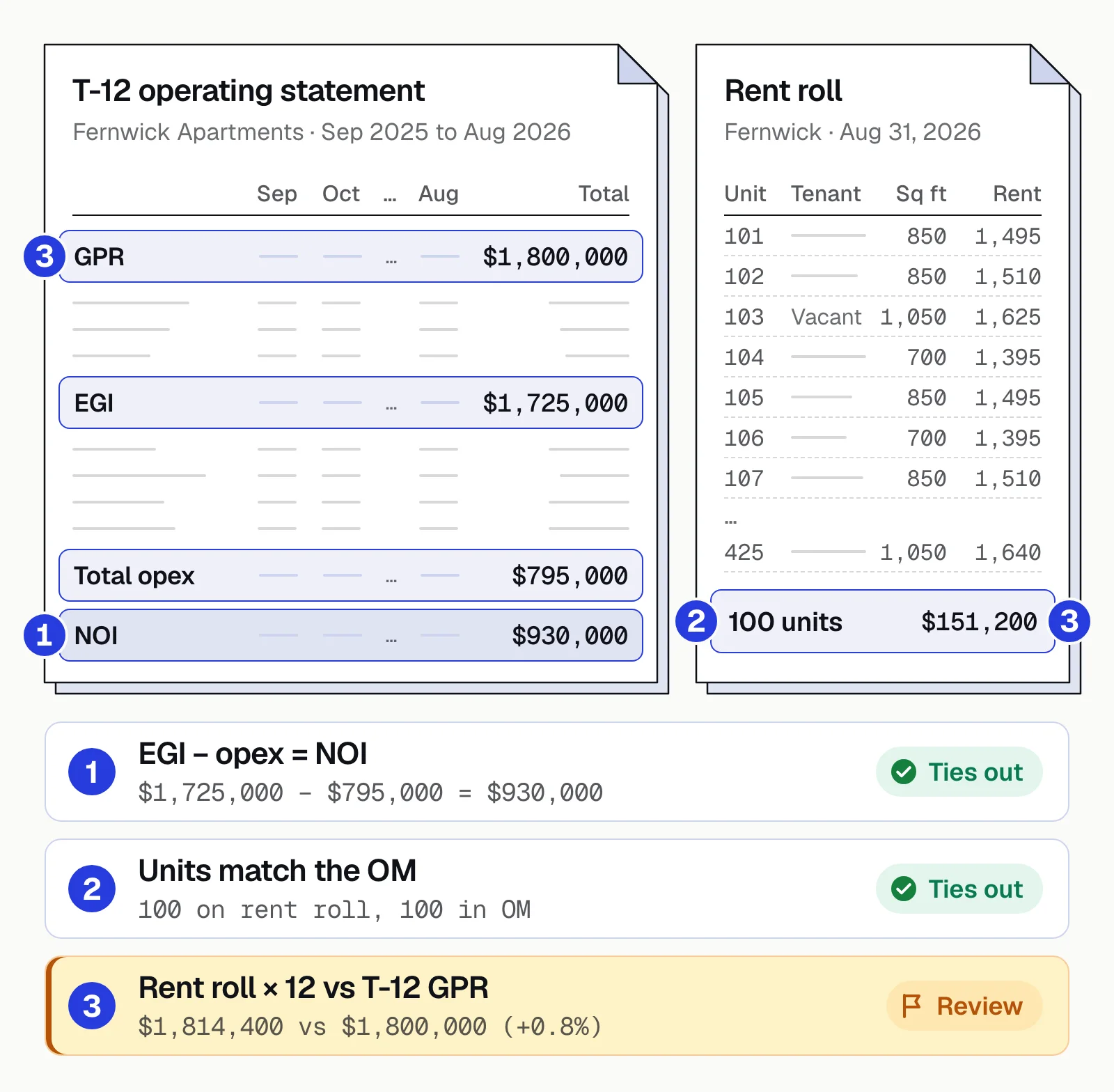
Most of the time in a manual process goes on the first two stages: retyping a 300-unit rent roll or mapping a property manager's chart of accounts onto your model's expense lines. That's the part software now automates best. It reads the lines the model needs, maps them the same way on every deal, and ties the documents out against each other, so figures that disagree are flagged before anyone builds the model.
The three kinds of CRE underwriting software#
Deal modeling and valuation
Build the pro forma, run scenarios and value the asset. Some now fill your model straight from the deal documents. Examples: Cactus, PropRise Primer, Archer, U-Rite, ARGUS Enterprise.CRE lending platforms
Built around the loan: origination, credit analysis, spreading and portfolio monitoring for lenders and servicers. Examples: Blooma, Clik.ai, Smart Capital Center.Document extraction
Reads OMs, T-12s, rent rolls and the rest of the file, checks the numbers and sends structured data to the model or system you already use. Example: Docsumo.
A fourth kind sits next to these: deal pipeline management, such as Dealpath, which tracks and compares deals across a team rather than modeling them.
The 10 best CRE underwriting software tools#
Docsumo is our product, so we've put it first and said plainly what it doesn't do. The other nine are grouped by what they're built for.
1. Docsumo
Document extractionOur product- Reads
- Operating statements, rent rolls, OMs and the rest of the loan file
- Output
- API and webhooks into your model or system; fields the model is unsure about go to a reviewer first
- Pricing
- A free 14-day trial for up to 1,000 pages; Business and Enterprise plans are quoted
- 99%field-level accuracy across 250+ document types
- 95%+of documents processed straight through, without manual review
2. Cactus
Deal modeling- Reads
- P&Ls, T-12s, rent rolls, OMs and budgets, plus lease clauses such as CAM and NNN recoveries
- Output
- Excel exports with working formulas; API access on its top tier
- Pricing
- Three tiers (Core, Plus, Max), prices not published; no per-seat charges
3. PropRise Primer
Deal modeling- Reads
- OMs, rent rolls, T-12s and operating statements
- Output
- Your existing Excel model
- Pricing
- Not published; sales-led
4. Archer
Deal modeling- Reads
- Rent rolls and T-12s, scanned pages included
- Output
- An Excel add-in that loads your own model; an Open API for Pro clients, with MCP support rolling out
- Pricing
- An annual platform fee plus one of three models (by deals analyzed, by deals closed, or unlimited); unlimited users
5. U-Rite
Deal modeling- Reads
- Document extraction isn't described on its site
- Output
- Excel, with ARGUS file conversion on its Pro tier
- Pricing
- Published tiers from a free Lite plan up to Pro; see its pricing page for monthly vs annual rates
6. ARGUS Enterprise
Valuation- Reads
- Rent rolls, through the ARGUS Intelligence rent roll upload (lease and step-level data); other document ingestion isn't described
- Output
- 40+ standard asset and portfolio reports, with property management system integrations
- Pricing
- A tiered, asset-based subscription; prices not published
7. Blooma
CRE lending- Reads
- OMs, rent rolls, operating statements, construction budgets, personal financial statements, schedules of real estate and tax returns
- Output
- Integrations with property management, CRM and modeling tools (not itemized on its site)
- Pricing
- Two plans (Pro and Enterprise), set by team size and annual origination volume; prices not published
8. Clik.ai
CRE lending- Reads
- T-12s, rent rolls and operating statements
- Output
- Excel-compatible models, an Excel add-in, an API and a Salesforce sync
- Pricing
- Not published; demo-led
9. Smart Capital Center
CRE lending- Reads
- Financial statements, rent rolls, appraisals, OMs and leases
- Output
- Integrations with Yardi, SS&C Precision and Midland Enterprise
- Pricing
- A free Starter plan, a Professional plan priced per property, and custom Enterprise pricing; unlimited users on every plan
10. Dealpath
Deal pipeline- Reads
- OMs, rent rolls, T-12s, BOVs and pro formas
- Output
- Integrations with Excel, Outlook, Box, Dropbox, CompStak and others; an open API on its Enterprise plan
- Pricing
- Two plans, prices not published; plans typically have a five-user minimum
CRE underwriting software compared#
| Tool | Documents it reads | Output | Pricing (as published) |
|---|---|---|---|
| Document extraction1 tool | |||
| DocsumoOur product | API, webhooks | Free trial; quoted plans | |
| Deal modeling and valuation5 tools | |||
| Cactus | Excel with formulas; API on top tier | Not published; no per-seat fees | |
| PropRise Primer | Your Excel model | Not published | |
| Archer | Excel add-in; API on Pro | Platform fee plus per-deal or unlimited | |
| U-Rite | Not described | Excel; ARGUS conversion | Free Lite plan; paid tiers listed |
| ARGUS Enterprise | 40+ reports | Asset-based subscription | |
| CRE lending3 tools | |||
| Blooma | Integrations (not itemized) | Not published | |
| Clik.ai | Excel, add-in, API, Salesforce | Not published | |
| Smart Capital Center | Yardi, SS&C Precision, Midland | Free Starter; per-property Professional | |
| Deal pipeline1 tool | |||
| Dealpath | Integrations; API on Enterprise | Not published; usually 5+ users | |
How to choose CRE underwriting software#
- Start with the documentsList what arrives with a typical deal: OMs, T-12s, rent rolls, leases, borrower financials. Rule out any tool that can't read the ones you get most.
- Decide whether you keep your modelIf your team trusts its Excel model or ARGUS, choose a tool that fills it (Primer, Archer, Docsumo). If you want the tool to be the model, look at Cactus, U-Rite or a lending platform.
- Check traceabilityClick a number in the output. You should land on the page and line it came from. Credit committees and investment committees will ask.
- Test on your messiest filesScanned T-12s, rent rolls with hundreds of units, property managers' own charts of accounts. Clean demo deals hide the problems.
- Compare pricing models, not just pricesPer seat, per deal, per property and per page scale very differently. Work out the cost at your real deal volume.
Checks to run on extracted T-12s and rent rolls#
Extraction only helps if the numbers are right. Whatever tool you use, these checks catch most of the errors before they reach the model. Our guides to extracting data from T-12s and rent rolls and what a T-12 contains go deeper.
- Rent roll totals tie outThe sum of unit rows matches the rent roll's own summary for units, square footage and monthly rent.
- T-12 months add upTwelve monthly columns sum to the annual totals, and income minus expenses equals the stated NOI.
- Occupancy agreesOccupancy from the rent roll matches the OM and the T-12's rental income.
- Line items map the same way every timeEach property manager's expense labels land in the same lines of your model.
- Lease dates are completeEvery unit has a lease start and end, so rollover risk is visible.
CRE due diligence for lenders#
A lender's loan file also holds borrower financials, tax returns, bank statements, insurance certificates and leases that need checking against each other, so many CRE lenders pair an underwriting tool with document automation for lending across the whole file. If your work is more about leases and property records than deals, see our guide to real estate document management software.
The bottom line#
Pick by the job, not the feature list. If you want a tool to build and run the deal model, shortlist Cactus, PropRise Primer or Archer, with ARGUS Enterprise or U-Rite for Excel-first valuation. If you lend, start with Blooma or Clik.ai. If you already have the model or loan system you trust and the bottleneck is getting clean numbers out of T-12s, rent rolls and the rest of the file, that's what Docsumo does.
Book a demo and bring a few of your own T-12s and rent rolls, or start a free trial.
Frequently asked questions#
What is CRE underwriting software?
CRE underwriting software helps investors and lenders evaluate a commercial property: it reads the deal documents (offering memorandum, T-12 operating statement, rent roll, leases), builds the cash flow, and calculates value, returns or debt metrics such as DSCR and debt yield.
What software do CRE underwriters use?
Most CRE underwriters still work in Excel models, often alongside ARGUS Enterprise for valuation. Newer tools such as Cactus, PropRise Primer and Archer fill those models from the deal documents, while lenders use platforms like Blooma and Clik.ai. Document extraction tools such as Docsumo feed T-12 and rent roll data into whichever model or loan system a team already uses.
Can AI underwrite a commercial real estate deal?
AI can do most of the data work: reading OMs, T-12s and rent rolls, normalizing line items, flagging numbers that disagree between documents and filling the model. The judgment calls, such as market assumptions, exit cap rates and credit decisions, still sit with the underwriter.
How do you automate rent roll analysis?
Extract every unit row (unit, tenant, square footage, rent, lease start and end), check that the unit totals match the rent roll summary, then map the output to your model's columns. See our guide to rent roll automation.
What's the difference between CRE underwriting software and a loan origination system?
Underwriting software analyzes the property and the deal. A loan origination system manages the loan itself: the application, approvals, documents and closing. Lenders often use both, with extracted document data flowing into each.
Sources
- Cactus: product and pricing pages
- PropRise: Primer product page
- Archer: platform and pricing pages
- Archer: underwriting page (Excel add-in, Open API)
- U-Rite: pricing page
- Altus Group: ARGUS Enterprise
- Altus Group: ARGUS Intelligence release notes (rent roll upload)
- Blooma: solutions page (documents it parses)
- Blooma: plans page
- Clik.ai: auto-underwriting product page
- Smart Capital Center: pricing page
- Smart Capital Center: homepage (documents it reads)
- Dealpath: AI page
- Dealpath: plans page (five-user minimum)
First published . Last updated .