ACORD 28: the evidence of commercial property insurance, field by field
For commercial lenders, loan servicers and insurance tracking teams. It covers what an ACORD 28 shows, what to check it against and how to stop keying it by hand.

Key takeaways
- The ACORD 28 is the Evidence of Commercial Property Insurance. An agent or broker issues this one-page form to a lender or other party with a financial interest in a commercial property.
- Each form covers one insurer's policy. It lists the property, the amount of insurance, the causes of loss and the deductible. It adds yes/no questions on coverages such as business income and flood. It also shows the lender's interest with the loan number.
- The form is evidence, not coverage. It only shows that a policy exists and does not change the policy. If the form and the policy disagree, the policy and its endorsements decide.
- Lenders check amount of insurance, special form, replacement cost, wind and flood deductibles, the mortgagee clause, the loan number and the dates against the loan.
- To automate ACORD 28 review, read every field and run those checks. Then send only the forms that fail to a person.
On this page
ACORD 28 is the Evidence of Commercial Property Insurance. An agent or broker sends this one-page form to a lender or other party with a financial interest in the property. It shows that a property policy is in force, what it covers and on what terms. It also names the lender's interest and loan number. It is for information only, like other ACORD forms. The policy itself governs.
The second half of this post covers the checks a lender runs against the loan, and where software can take over.
What is an ACORD 28?#
ACORD is the nonprofit that maintains the insurance industry's standard forms. It describes the ACORD 27 and 28 as certificates of insurance for parties with a financial interest in the insured property, usually lenders. Lenders prefer the title "Evidence of" to "Certificate of".
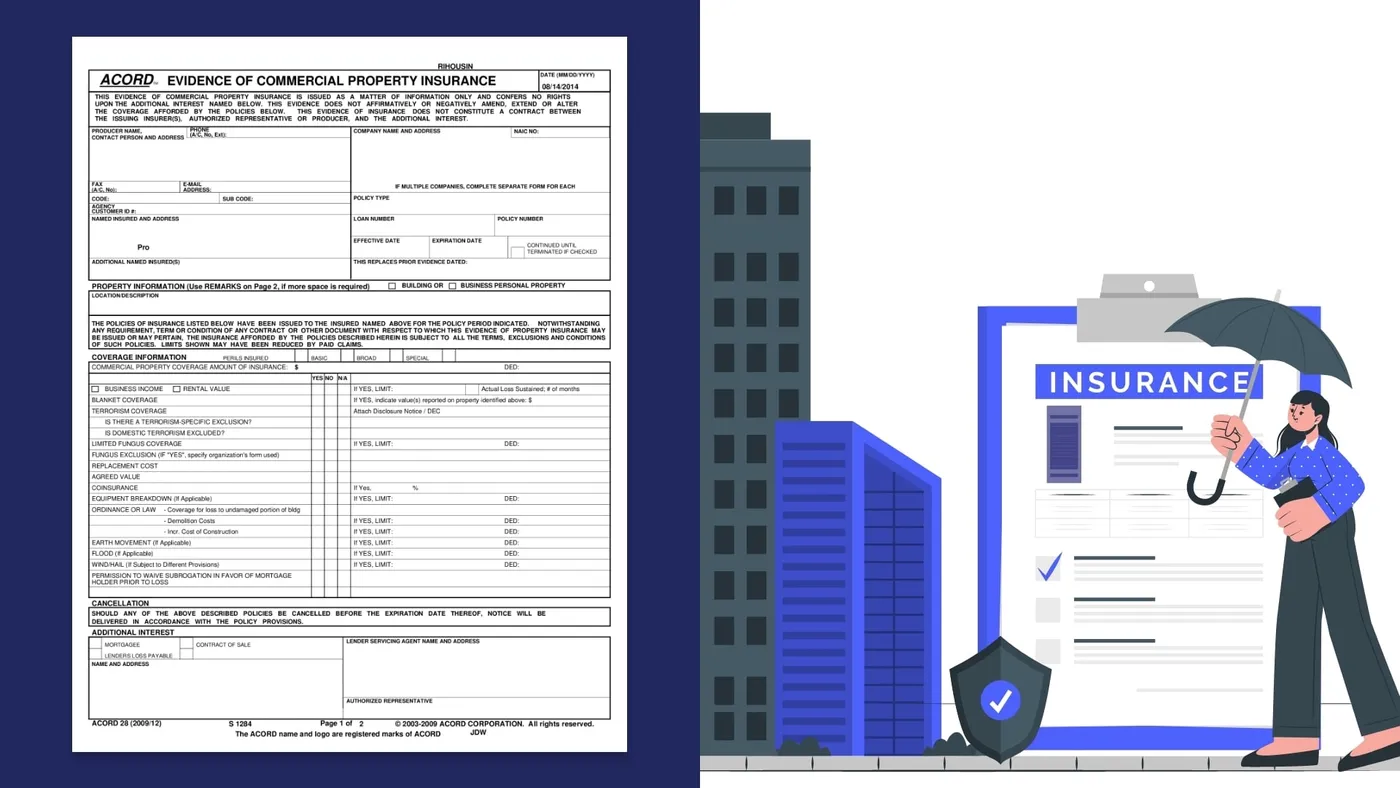
The current edition is ACORD 28 (2016/03), per ACORD's forms index revised in September 2026. It fits on one page and takes an ACORD 101 Additional Remarks Schedule when more room is needed. The older 2009/12 edition, shown in the header image, had a second page for remarks.
Each form covers one insurer. The form tells agents to complete a separate one for each company, so a property insured by several carriers arrives with several ACORD 28s. People also confuse it with three other ACORD forms.
ACORD 28, evidence of commercial property insurance
For a lender or other party with a financial interest in a commercial property. It has set questions on causes of loss and valuation, on deductibles, and on coverages such as business income or named storm.ACORD 27, evidence of property insurance
The simpler evidence form. It lists coverages as free-form lines with amounts and deductibles, plus a remarks box. See our ACORD 27 guide.ACORD 24, certificate of property insurance
Property coverage reported to a certificate holder, laid out like the ACORD 25. It has up to six insurers and lines for building, personal property, business income, inland marine, crime and equipment breakdown.ACORD 25, certificate of liability insurance
Liability coverage for a certificate holder such as a landlord or general contractor. See our ACORD 25 guide.
Commercial applications
Evidence of property insurance
ACORD 125: Commercial insurance application
Agents and brokers send it to carriers and MGAs, with the line sections.✓ 3 passedThe first section of a commercial submission: the applicant, its premises and the lines it wants quoted.
What Docsumo reads
- Applicant
- Keystone HVAC LLC
- FEIN
- ••-•••6120
- NAICS
- 238220
- Proposed term
- 2026-07-01 → 2027-07-01
- Sections attached
- GL, property, auto, umbrella
- Full-time employees
- 46
- Annual revenues
- 8,450,000
- Premises 1
- 2150 Liberty Ave, Pittsburgh, PA 15222
Checked against
- SubmissionEvery section ticked is attached✓ 4 of 4 in
- Every sectionApplicant, FEIN and proposed term✓ Same on all
- Your rulesNAICS code against the classes you write✓ Accepted
The rules each form is checked against are yours to set.
How an ACORD 28 moves from agent to lender#
The borrower's agent issues the form when the loan closes and again at each renewal. The lender or its servicer checks it against the insurance requirements in the loan documents. The Additional Interest box names the lender or other party. It also marks that party's interest as mortgagee, lender's loss payable, loss payee or contract of sale.
- Borrower's agent or broker
- Insurance inbox
- Servicing portal
- 01Classify
- 02Extract every field
- 03Check against the loan
- 04Review exceptions
Lenders need the form as data, not just as a PDF. Fannie Mae, for example, has its multifamily lenders upload insurance documents, the ACORD 28 among them. The lenders also submit the insurance details as data in set fields of its DUS Insurance Data Set (Form 4087.INS).
The sections of an ACORD 28, and what to extract#
The table takes each part of the 2016/03 edition in turn, with the fields worth extracting and what they are used for.
| Section | Fields to extract | Used for |
|---|---|---|
| Header | Date issued; "this replaces prior evidence dated" | Knowing which evidence is current |
| Agency | Producer, contact, phone, email, agency code and customer ID | Requesting corrections |
| Company | Insurer name and NAIC number (one insurer per form) | Checking the insurer's rating |
| Named insured | Named insured, additional named insureds, address | Matching the borrower |
| Policy | Policy type and number, loan number, effective and expiration dates, "continued until terminated" | Linking the form to the loan; dates |
| Property information | Building or business personal property; location and description | Matching the collateral |
| Coverage information | Perils insured (basic, broad or special), amount of insurance, deductible | The core coverage check |
| Coverage questions | Yes, no or N/A, with limits and deductibles where they apply: business income or rental value, blanket coverage, terrorism, fungus, replacement cost, agreed value, coinsurance, equipment breakdown, ordinance or law, earth movement, flood, wind or hail, named storm, and waiver of subrogation for the mortgage holder | The loan's coverage requirements |
| Additional interest | Mortgagee, lender's loss payable, loss payee or contract of sale; name and address; lender servicing agent | The mortgagee clause check |
| Authorized representative | Signature | Validity |
The checks to run against the loan#
Each check compares the form with the insurance requirements in the loan documents. The thresholds below are Fannie Mae's for multifamily loans, as an example. Your own loan documents set yours.
- Amount of insuranceAt least what the loan requires. Fannie Mae asks for 100% of estimated insurable value on a single-building property. For a multiple-building property it asks for 90%.
- Causes of lossThe Special box is checked. Basic and Broad cover only the causes of loss they list. Special covers any cause that the policy does not exclude.
- Valuation and coinsuranceReplacement cost is Yes. Coinsurance is No or offset by agreed value.
- Mortgagee clause and loan numberYour exact clause, and the right loan number. One example clause is "Fannie Mae, its successors and/or assigns, as their interest may appear" in care of the lender.
- DatesThe policy is in force at closing. Track the expiration date so renewal evidence arrives before the policy lapses.
- Wind, flood and earthquakeFlood, earth movement, wind and hail, and named storm are covered where the property needs them, with deductibles inside your limits. Fannie Mae caps wind and hail deductibles at 5% of total insurable value. It caps named storm and earthquake at 7.5%.
- One insurer per formA property insured by several carriers comes with several ACORD 28s, so check the program as a whole.
Here is a typical exception. The building limit is enough for the loan and the causes of loss are Special, but the loan number is missing. So the form goes to a person, not straight into the servicing system.
Our take. Judge ACORD 28 automation by the whole loan file, not by the single form. A form can be read perfectly and still fail the loan. The mortgagee clause may differ from the loan agreement, or the declarations page may show another limit. We would put the effort into comparing the form with the other documents in the file. That comparison decides whether the lender is protected.
How to automate ACORD 28 processing#
- Collect evidence in one queueRoute the insurance inbox, servicing portal uploads and scans to one place.
- Classify and splitSeparate the ACORD 28 from the ACORD 25, declarations pages, endorsements and ACORD 101 remarks that often come with it. Docsumo classifies and splits mixed packets on its Business plan.
- Extract every fieldInclude each yes/no answer with its limit and deductible, and the additional interest. Docsumo reads ACORD forms, scans included, and reports 99% field-level accuracy across 250+ document types.
- Check against the loanRun the checks above with each loan's requirements. Docsumo's Enterprise plan can compare the form with other documents in the file, such as the policy's declarations page. This is called cross-document validation.
- Review exceptionsFields the model is unsure about go to a person. Clicking a field highlights where it sits on the page. When a check fails, request a corrected form from the agent.
- Send the data onPush it to your loan servicing or insurance tracking system through an API and webhooks. Track each expiration date there.
Vertikal RMS uses Docsumo for COI verification through ACORD capture, and Arbor reached 99% accuracy on insurance compliance documents with it.
- 99%field-level accuracy across 250+ document types
- 95%+of documents processed straight through, without manual review
What to do with each ACORD 28 that arrives#
An ACORD 28 gives a lender a one-page view of a commercial property policy. Its value comes from checking it against the loan. Extract every field, including the yes/no questions and the additional interest. Run the same checks on every form, and send people only the ones that fail.
Book a demo with a few of your own ACORD 28s, or start a free trial.
Frequently asked questions#
What is an ACORD 28 form?
ACORD 28 is the Evidence of Commercial Property Insurance. An insurance agent or broker completes this standard form. It shows a lender, loss payee or other interested party that a commercial property policy is in force. The current edition is ACORD 28 (2016/03).
What is the difference between ACORD 25 and ACORD 28?
ACORD 25 is the certificate of liability insurance. It goes to a certificate holder such as a landlord or general contractor. ACORD 28 is evidence of commercial property insurance. It goes to a party with a financial interest in the property, usually a lender. ACORD uses two forms because a property policy typically requires the insurer to notify the mortgage holder of a cancellation. A liability policy notifies only the first named insured on the policy.
What is the difference between ACORD 27 and ACORD 28?
Both are evidence forms for parties with a financial interest in a property. The ACORD 27 lists coverages as free-form lines with a remarks box. The ACORD 28 is built for commercial property, with set questions on business income, blanket coverage, terrorism, replacement cost, coinsurance, flood, wind and named storm. See our ACORD 27 guide.
How do you fill out an ACORD 28?
The insured's agent or broker completes it from the policy. It carries the agency and insurer, the named insured, the policy and loan numbers, the dates, the property, the coverage information and the additional interest. An authorized representative signs it. The lender supplies its mortgagee clause and loan number. Blank forms come from ACORD to agencies that subscribe to an eligible forms program.
Is an ACORD 28 proof of insurance?
It's evidence, not a contract. The form says it's issued as a matter of information only and doesn't amend, extend or alter the policies it describes. Some lenders treat it as temporary evidence only. Fannie Mae's multifamily guide accepts an ACORD 28 with an ACORD 25 at closing, but not as permanent evidence. Permanent evidence has to be the policy or, for loans of $10 million or less, the MBA's evidence of commercial property insurance form.
Can ACORD 28 data be extracted automatically?
Yes. Docsumo reads ACORD forms, including the ACORD 28, scans as well as digital PDFs, and sends fields it's unsure about to a person for review. See ACORD form extraction.
Sources
- ACORD Forms Index (rev. 9/8/2026)
- ACORD: Certificates of insurance, frequently asked questions
- ACORD: Forms library
- ACORD 28 (2016/03) Evidence of Commercial Property Insurance, blank form (NYC Department of Design and Construction)
- ACORD 27 (2016/03) Evidence of Property Insurance, blank form (NYC Department of Design and Construction)
- ACORD 24 (2016/03) Certificate of Property Insurance (Texas Department of Insurance)
- Fannie Mae Multifamily Guide 501.01A: General insurance, applies to all policies
- Fannie Mae Multifamily Guide 501.01H: Evidence of insurance
- Fannie Mae Multifamily Guide 501.02: Property insurance (minimum coverage amounts, deductibles)
- IRMI: Causes of loss forms
First published . Last updated .