99%+ Accurate Healthcare Workflows with Intelligent Document Processing


Docsumo processes every document in your healthcare pipeline, from prior authorization requests and insurance claims to patient intake forms and medical records, with 99%+ accuracy, so your clinical and administrative teams spend less time on paperwork and more time on patient care.
Trusted by 1,000+ healthcare and health services teams
Arbor partners with Docsumo for accurate document processing
Nomura partners with Docsumo for accurate document processing
Silicon Bank Valley partners with Docsumo for accurate document processing
Sardine partners with Docsumo for accurate document processing
Built for Healthcare Organizations Who Need

Less Paperwork. Faster Onboarding.

Unstructured medical to decision-ready data in seconds

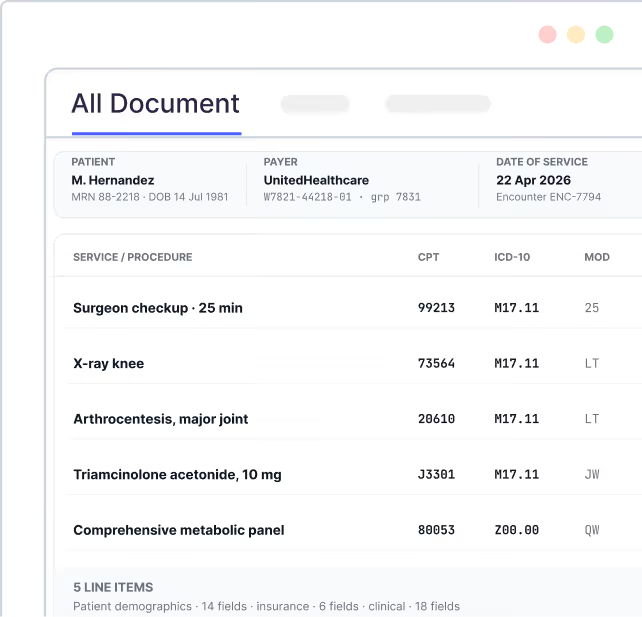
Your clinical operations team shouldn't be a document processing department. Docsumo's Intelligent Document Processing (IDP) for healthcare extracts structured data from prior authorization requests, insurance claim forms, patient intake packets, medical records, and EOBs, in whatever format they arrive, and returns validated, system-ready data with 99%+ accuracy. When your team opens a patient file, the data entry is already done.

Same administrative headcount. 5x more cases handled.

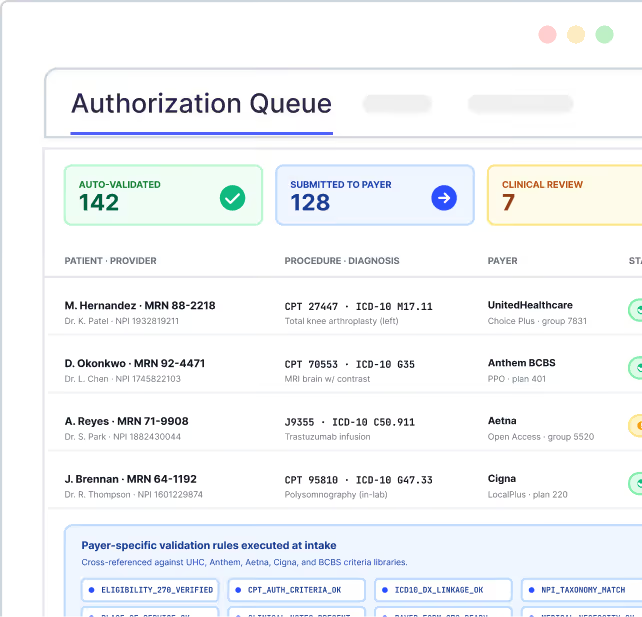
Physicians spend an average of 13 hours per week on prior authorization requests alone. Docsumo's AI workflow agents handle the document-heavy back-office work: ingesting patient and payer documents from any channel, classifying forms, flagging incomplete submissions, and routing completed packets to the right department.

Reduce claim denials before they reach the payer

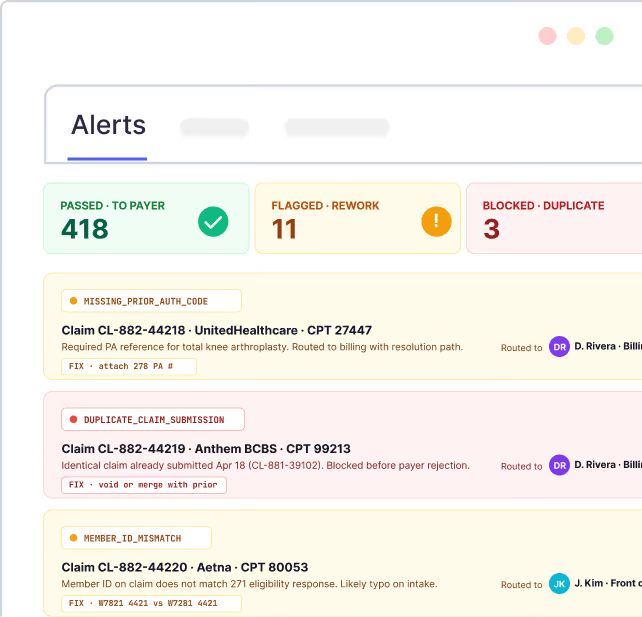
25% of in-network claim denials are driven by administrative errors, not clinical necessity. Docsumo validates every claim document at intake, checking for missing prior authorization codes, mismatched member IDs, incomplete clinical documentation, and formatting errors before submission.

Agentic AI built for healthcare complexity

LLM-augmented, self-improving IDP that adapts to new payer form formats, updated CPT and ICD code sets, and changing documentation requirements without re-training from scratch. It handles fax-originated referral packets, handwritten physician notes, and multi-payer EOB formats your legacy OCR tool never could. It connects directly to your EHR, practice management system, or revenue cycle platform through pre-built integrations and APIs. And it gets more accurate over time as your team resolves edge cases.

Numbers that matter

Healthcare Teams Do Extraordinary Things With Docsumo IDP

What Matters
Impact with Docsumo
What Matters
Impact with Docsumo
Extraction accuracy
99%+ across 50+ healthcare document types
Processing speed
10x faster than manual review
Medicaid applications processed per year
130,000+ at 99.81% accuracy
Hours saved per administrative team per month
100+
Reduction in claim denial rate from administrative errors
Up to 80%
Touchless processing rate
Up to 95% of documents, no human touch

Docsumo IDP Makes Healthcare Secure Again

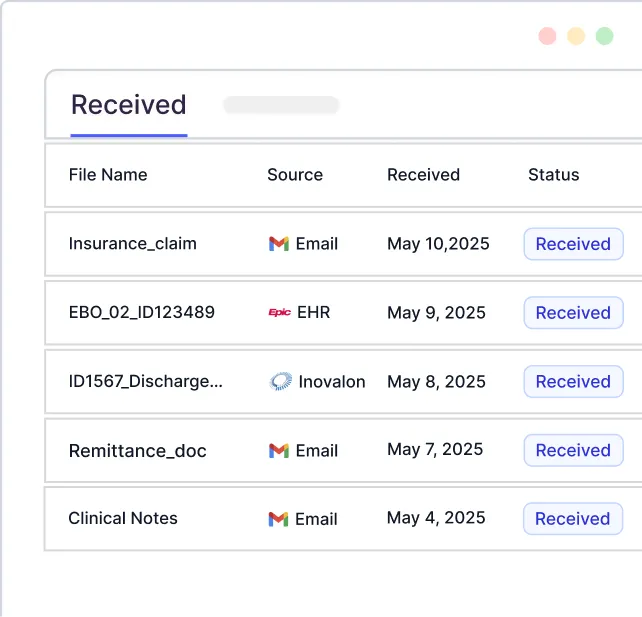
Receive patient and payer documents from any channel

Classify documents and check packet completeness

Extract patient data, procedure codes, and clinical details

Process prior authorization requests saving the 13-hours/ week

Catch administrative claim errors before submission

Connect with your EHR, practice management system, and payer portals
Built for Enterprise Healthcare Teams That Can't Afford a Compliance Gap

A blue shield icon featuring a graphical representation of a network node. The design suggests themes of security and protection, potentially relating to customizable data retention with transparent InfoSec policies and enterprise SSO authentication (SAML 2.0/OAuth 2.0).

Enterprise security framework

Customizable data retention with transparent InfoSec policies and enterprise SSO authentication (SAML 2.0/OAuth 2.0).

Compliance-ready infrastructure

SOC 2 Type 2, GDPR, and HIPAA-compliant systems with bank-grade SSL encryption for sensitive document management.


A blue shield icon featuring a graphical representation of a network node. The design suggests themes of security and protection, potentially relating to customizable data retention with transparent InfoSec policies and enterprise SSO authentication (SAML 2.0/OAuth 2.0).

Dedicated success strategy

Dedicated automation expert and customized success plans aligned with your business objectives for enterprise-scale implementation.

Secure sandbox testing

Test document processing in production-identical environments before deployment, ensuring seamless integration with zero disruption.

A blue shield icon featuring a graphical representation of a network node. The design suggests themes of security and protection, potentially relating to customizable data retention with transparent InfoSec policies and enterprise SSO authentication (SAML 2.0/OAuth 2.0).

Granular access controls

Role-based permissions, custom approval workflows, and comprehensive audit trails that meet enterprise governance requirements.

A blue shield icon featuring a graphical representation of a network node. The design suggests themes of security and protection, potentially relating to customizable data retention with transparent InfoSec policies and enterprise SSO authentication (SAML 2.0/OAuth 2.0).
Explore the Enterprise plan

FAQs About Intelligent Document Processing for Healthcare

What is intelligent document processing (IDP) for healthcare?

Intelligent document processing (IDP) for healthcare is AI-powered software that automatically ingests, classifies, extracts, validates, and routes data from clinical and administrative documents. That covers prior authorization requests, insurance claim forms, patient intake packets, medical records, EOBs, discharge summaries, referral documents, and Medicaid applications. Unlike traditional OCR software, modern IDP platforms use large language models and computer vision to handle unstructured, handwritten, and multi-format documents accurately. For healthcare teams, IDP replaces manual data entry and document review with automated workflows that feed directly into EHR systems, practice management platforms, and revenue cycle tools. For a deeper overview, see Docsumo's guide on healthcare document processing.

Is Docsumo HIPAA compliant for healthcare document processing?

Yes. Docsumo is SOC 2 Type 2, GDPR, and HIPAA compliant with bank-grade SSL encryption for all document handling. Access is controlled by role-based permissions and enterprise SSO (SAML 2.0/OAuth 2.0). Every document action is logged in a full audit trail that meets CMS and HIPAA documentation requirements. Data retention policies are customizable and transparently documented. See the full security and compliance posture on the Docsumo Enterprise page.

How does Docsumo integrate with our EHR and practice management system?

Docsumo connects to most major EHR platforms, practice management systems, and revenue cycle tools through API integrations. Extracted and validated data syncs in real time in your required format. No manual exports, no reformatting. For healthcare teams running on Salesforce Health Cloud, the Docsumo-Salesforce integration supports real-time patient and payer data validation against existing records and trigger-based workflow routing. Your IT team gets full API documentation and dedicated integration support throughout onboarding. Explore the platform overview for a full picture of how deployment works.

How does Docsumo integrate with our core banking system and LOS?

Docsumo connects to most major LOS platforms, core banking systems, CRMs, and risk platforms through API integrations. Extracted and validated data syncs in real time in your required format. No manual exports, no reformatting. Common integrations include Salesforce, Encompass, nCino, and custom-built platforms. For Salesforce-driven banking teams, the Docsumo-Salesforce integration supports real-time data validation and trigger-based deal routing. Your IT team gets full API documentation and dedicated integration support throughout onboarding.

How does IDP reduce claim denials for healthcare organizations?

IDP reduces claim denials by validating every document at intake before it reaches the payer. Docsumo's data validation layer checks for missing prior authorization codes, member ID mismatches, unsupported procedure-diagnosis code combinations, and formatting errors the moment a claim document is ingested. According to KFF's 2024 analysis, 25% of in-network claim denials are administrative in origin. Docsumo eliminates that category of denial at the source, before any rework cycle begins.

How does Docsumo handle prior authorization processing?

Docsumo extracts all required patient, provider, and procedure data from prior authorization submissions, cross-references them against your payer-specific authorization rules through configured validation checks, and routes completed, validated requests to the appropriate queue automatically. According to the American Medical Association, physicians and their staff spend an average of 13 hours per week completing prior authorization requests. Docsumo compresses that workload to a review queue of only the cases that genuinely require clinical judgment.

What types of healthcare documents can Docsumo process?

Docsumo processes the full range of healthcare administrative documents: prior authorization requests, insurance claim forms (CMS-1500, UB-04), patient intake and registration forms, medical records, discharge summaries, referral packets, EOBs, remittance advice, Medicaid applications, utility bills for facility management, and income verification documents. The platform's pre-trained models cover 50+ document types out of the box, and you can train custom AI models for payer-specific or specialty-specific formats. If your team processes it regularly, Docsumo can extract it with the same accuracy as your highest-volume document types.

What is the difference between Docsumo and traditional OCR for healthcare documents?

Traditional OCR software reads characters off a page. It doesn't understand that "Dx Code" and "Diagnosis Code" are the same field, can't handle a payer who updated their prior auth form layout last quarter, and fails entirely on handwritten physician notes. Docsumo uses large language models on top of OCR to understand what a healthcare document means, not just what it contains. It classifies document types via automatic document classification, extracts the right fields regardless of format variation, validates data against your payer and clinical rules, and flags exceptions for human review. Docsumo also improves over time as your team resolves edge cases. Legacy OCR tools do not. For a full breakdown, read Docsumo's IDP vs OCR guide.

Can Docsumo handle high document volumes during peak healthcare periods?

Yes. Docsumo processes millions of documents per month for enterprise healthcare clients. Cassena Care, a New York-based healthcare organization, processes over 130,000 Medicaid applications per year through Docsumo at 99.81% accuracy. The document automation platform handles open enrollment surges, end-of-year claim volume spikes, and Medicaid redetermination waves without additional configuration or staffing. The same AI agents processing 1,000 documents per week handle 10,000 with identical accuracy. See how Docsumo customers across healthcare have scaled operations without scaling their administrative teams.