The best KYC document verification software in 2026: 8 tools compared
For fintech, banking and lending teams choosing how to verify customers at onboarding: what each layer of a KYC check does, how 8 tools compare on documents, liveness and price, and how to test them on your own traffic.

Key takeaways
- KYC document verification software checks that a customer's ID is genuine, that the person presenting it is real and present, and that the details match data sources and watchlists, then passes the data to your onboarding system.
- The tools split into ID and selfie verification platforms (Entrust IDV, Jumio, Veriff, GBG), identity risk and orchestration platforms (Socure, Persona), payments-native checks (Stripe Identity) and document extraction (Docsumo).
- Veriff, Socure, Stripe Identity and Persona publish prices; the lowest list price is $0.80 per check, at Veriff and Socure. Entrust, Jumio and GBG quote on request.
- Ask every vendor for false rejection and completion rates on your own traffic, split by document type and country, not just a fraud catch rate.
- Docsumo reads the documents in a KYC file, with pre-trained models for passports and driver's licenses. It doesn't check that an ID is genuine, run liveness or screen watchlists, so teams pair it with an ID verification platform.
On this page
KYC document verification software checks a customer's identity document at onboarding: it captures the ID, checks it for tampering, matches the holder with a live selfie, checks the details against data sources and watchlists, and reads the data into your systems. Most tools cover several of those steps and few cover all of them, so teams often pair an ID verification platform with screening and document extraction.
Vendor details below come from each vendor's own website, checked in September 2026. Links are in the sources at the end.
What do you need to verify?
What KYC document verification software does#
A KYC check runs in layers. ID verification and screening tools cover the first five; document extraction covers the paperwork around the ID.
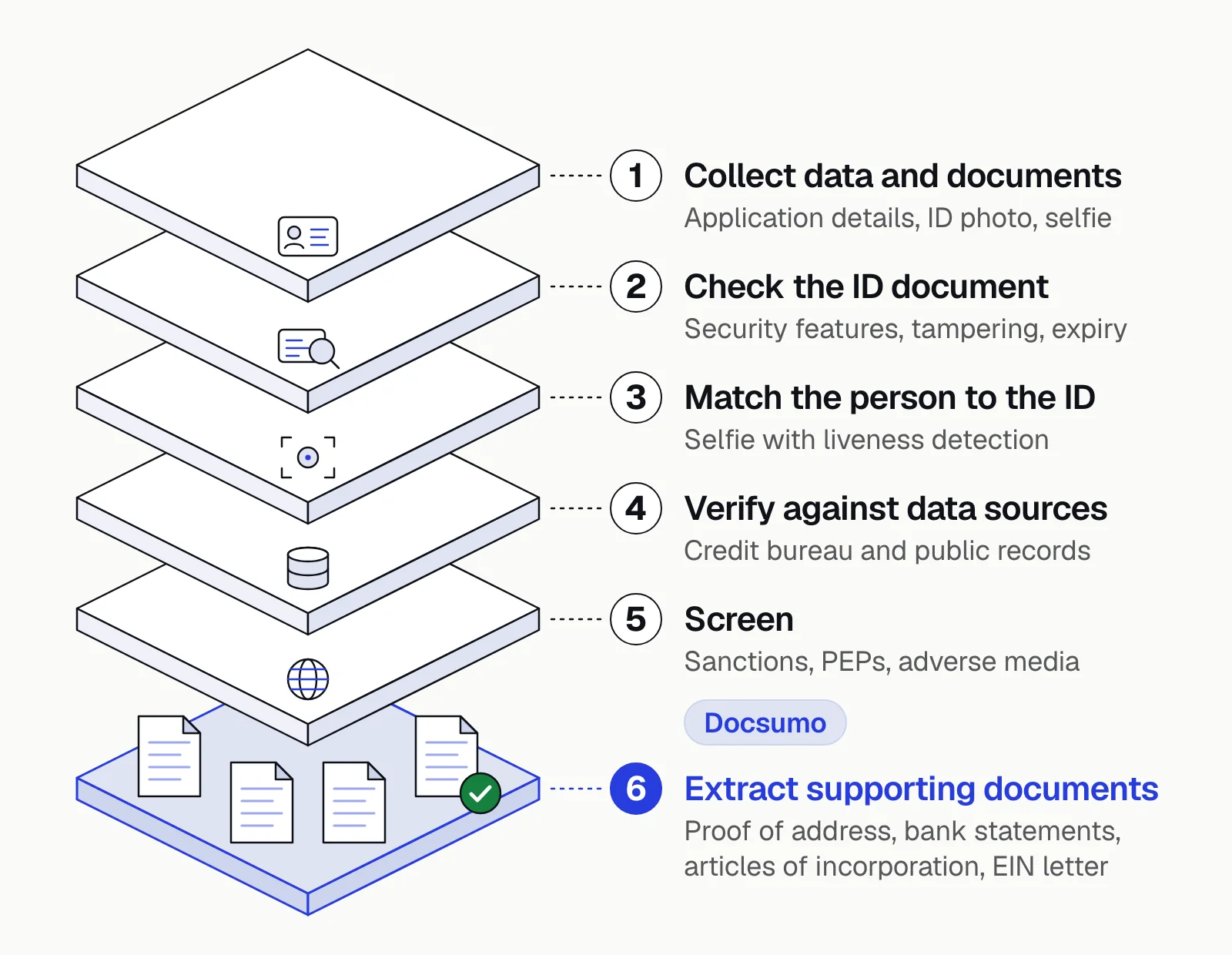
Collect data and documents
The customer enters their details and uploads an ID and a selfie, usually by phone camera. Guidance on glare, blur and cropping at this step helps genuine customers pass the later checks.Check the ID document
The tool reads the ID, then checks its security features, signs of tampering and expiry date.Match the person to the ID
A selfie with liveness detection is compared with the ID photo, so a printed photo or a replayed video should fail.Verify against data sources
Name, date of birth, address and ID number are checked against credit bureau and public records.Screen
Sanctions lists such as OFAC's, politically exposed persons and adverse media.Extract supporting documents
Proof of address, bank statements, pay stubs and business documents are read and compared with the application.
The numbers to ask vendors for#
Ask vendors for these three numbers, measured on your own traffic rather than their test set. Slow onboarding costs clients: in Fenergo's 2025 survey of 600 senior decision-makers at banks, asset managers and fund administrators, 70% said their firm had lost clients in the past year to slow or inefficient onboarding.
False rejection rate
The share of genuine customers the tool declines. At 10,000 genuine applicants a month, a 5% rate turns away 500 of them.Completion rate
The share of people who start verification and finish it, which counts drop-offs as well as rejections. Ask what the vendor counts as a start.Fraud catch rate
The share of fake or altered documents it stops. On its own, it says nothing about genuine customers with unusual documents.
The 8 best KYC verification software tools#
Docsumo is our product, so we've put it first and said plainly what it doesn't do. The others are grouped by what they're built for.
Document extraction
1. Docsumo
Document extractionOur product- Reads
- Passports and driver's licenses (pre-trained models), proof of address, bank statements, pay stubs, tax forms and business formation documents; any document type
- Checks
- Low-confidence fields go to your reviewers; cross-document validation, on the Enterprise plan, checks the documents in a file against each other
- Workflow steps
- Steps you set up, such as decoding a license's PDF417 barcode with a barcode library to compare with the front, or recomputing passport MRZ check digits in a code step
- Output
- Structured data through an API and webhooks, or an Excel export
- Pricing
- A free 14-day trial for up to 1,000 pages; Business and Enterprise plans are quoted
Here's the extraction layer on a US driver's license: the fields on the front, and the barcode on the back decoded and compared with them. Driver's license OCR covers the barcode fields in detail.
| Field | Extracted value | Confidence |
|---|---|---|
| License number | D4827-19305-66 | |
| Class | D | |
| Issue date | 2021-07-15 | |
| Expiration date | 2029-07-22 |
| Field | Extracted value | Confidence |
|---|---|---|
| Last name | RENNICK | |
| First and middle | JONAH T | |
| Address | 418 Alder Row, Fairhaven, LM 55017 | |
| Date of birth | 1991-07-22 | |
| Sex | M | |
| Height | 5'10" (70 in) |
| Field | Extracted value | Confidence |
|---|---|---|
| DAQ license number | Matches the front | |
| DCS / DAC name | Matches the front | |
| DBB date of birth | Matches the front | |
| DBA expiration | Matches the front | |
| Front matches barcode | Yes |
ID and selfie verification platforms
2. Entrust IDV (formerly Onfido)
ID and selfie verification- Reads
- 2,500+ document types from 195 countries, plus photo, video or motion selfies
- Liveness
- Passive for photo selfies; active for Motion and Video (head turns, spoken digits), with Motion at iBeta Level 2
- Output
- API, mobile and web capture SDKs, Workflow Studio and a dashboard
- Pricing
- Not published
3. Jumio
ID and selfie verification- Reads
- 5,000+ ID types from 200 countries and territories, including mobile driver's licenses, plus selfies
- Liveness
- Premium Liveness with patented active illumination (no gestures), iBeta Level 2
- Output
- API, SDKs and integrations, returning ID data, authenticity and liveness results and a risk decision
- Pricing
- Not published
4. Veriff
ID and selfie verification- Reads
- 12,500+ documents from 230+ countries and territories, plus selfies; the user flow runs in 50 languages
- Liveness
- Passive (no head turns or extra selfies), iBeta Level 1 and 2
- Output
- API, web flow, native SDKs and decision webhooks
- Pricing
- Essential $0.80 per verification ($49 monthly minimum), Plus $1.39, Premium $1.89; PEP and sanctions screening $0.64 extra; 5,000+ a month quoted (published)
5. GBG (formerly Acuant)
ID and selfie verification- Reads
- 8,500+ government-issued IDs from 195 countries, NFC chips and selfies; identity data checks in 50+ countries
- Liveness
- Passive
- Output
- One integration to 80 modules for verification, risk and fraud
- Pricing
- Not published
Identity risk and orchestration platforms
6. Socure
Identity risk and orchestration- Reads
- Driver's licenses, passports, visas and national IDs: every US state and territory, tribal IDs, green cards and Canadian provinces, plus 195+ countries; selfies
- Liveness
- Selfie match with NIST PAD Level 2 liveness (a single selfie, no head turns)
- Output
- API or hosted UI, with RiskOS workflows and decisions
- Pricing
- Socure Launch: $1,000 a month in credits, then $0.80 per DocV check; enterprise quoted (published)
7. Persona
Identity risk and orchestration- Reads
- Government IDs, selfies, NFC, digital IDs and mobile driver's licenses; database checks (including AAMVA and eCBSV in the US), phone, email and business registries
- Liveness
- Its own selfie liveness, iBeta Level 1 and 2, on all plans
- Output
- API, hosted and embedded flows, mobile SDKs and webhooks
- Pricing
- Essential from $250 a month (12-month minimum), billed per successful verification; Growth and Enterprise quoted (published)
Payments-native ID checks
8. Stripe Identity
Payments-native- Reads
- Driver's licenses, ID cards and passports from 100+ countries, plus selfies
- Liveness
- Selfie match with manipulation checks; liveness type not stated
- Output
- API, a prebuilt UI through Stripe's SDKs and the Stripe Dashboard
- Pricing
- $1.50 per ID and selfie check, $0.50 per US ID number lookup, first 50 free; quoted above 2,000 a month (published)
Document verification software compared#
| Tool | Coverage | Liveness | Pricing |
|---|---|---|---|
| Document extraction1 tool | |||
| DocsumoOur productThe documents in KYC and loan files | Passports, driver's licenses, proof of address, bank statements; any document type | Not included | Free trial; quoted plans |
| ID and selfie verification4 tools | |||
| Entrust IDV (formerly Onfido)Choice of passive or active liveness | 2,500+ document types, 195 countries | Passive and active | Not published |
| JumioID, liveness, risk and AML from one vendor | 5,000+ ID types, 200 countries and territories | Premium (active illumination), iBeta Level 2 | Not published |
| VeriffGlobal users, published prices | 12,500+ documents, 230+ countries and territories | Passive, iBeta Level 1 and 2 | From $0.80 per verification |
| GBG (formerly Acuant)Document, biometric and data checks from one supplier | 8,500+ IDs, 195 countries | Passive | Not published |
| Identity risk and orchestration2 tools | |||
| Socure (DocV)US-focused fintechs and lenders | All US states and Canadian provinces; 195+ countries, mostly passports | NIST PAD Level 2 | $0.80 per DocV check after $1,000/mo in credits |
| PersonaCustom flows built by your engineers | Government IDs, database and business checks | Own selfie liveness, iBeta Level 1 and 2 | From $250/mo + per verification |
| Payments-native1 tool | |||
| Stripe IdentitySimple checks inside Stripe | Government IDs from 100+ countries | Selfie match; type not stated | $1.50 per ID and selfie check |
How to run a KYC tool evaluation#
Demo data flatters every tool. These steps test them on yours.
- Build the test set from your failuresPull the last 90 days of failed verifications and tag each by failure reason. Include uploaded PDFs and scans as well as phone captures.
- Split results by document and countryAsk each vendor to report on your test set by document type, issuing country and capture quality. A strong overall rate can hide a weak one on the IDs many of your customers hold.
- Measure completion, not step accuracyCount how many people who start verification finish it. A tool with slightly lower document accuracy but fewer drop-offs can onboard more customers.
- Test your fraud scenariosIf printed photos, screen replays or edited documents worry you, build controlled test cases and ask when the models were last updated for them.
- Run vendors in parallelSend the same live traffic to two or three vendors for 30 to 60 days, logging their decisions without acting on them, then compare.
- Check the integration and the recordsHave an engineer build a test integration against each shortlisted API: documentation, error messages and webhooks. Then check the tool keeps the records below.
What your verification records need to show#
For US banks, the Customer Identification Program rule (31 CFR 1020.220) sets what the record of each verification must hold. "It passed the API" isn't a record, so check that your tool stores these or passes them to a system that does:
- The customer's identifying informationName, date of birth, address and identification number, as collected.
- The document relied onIts type, ID number, place of issuance and, if any, its issue and expiration dates.
- Other verificationThe methods and results of any other checks, such as database matches.
- DiscrepanciesHow each substantive discrepancy was resolved.
- RetentionKeep verification records for five years after they're made, and the customer's identifying information for five years after the account closes.
The bottom line#
For ID and selfie checks worldwide, compare Veriff, Entrust IDV, Jumio and GBG on your own traffic. For US identity risk decisions, look at Socure; to design your own flows, Persona; for simple checks inside Stripe, Stripe Identity. Whichever you choose, judge it on false rejection and completion rates from your data, not the vendor's. Docsumo sits alongside any of them in a KYC workflow, reading the ID data and the rest of the file, from proof of address to bank statements and business documents.
Book a demo and bring a few of your own onboarding files, or start a free trial.
Frequently asked questions#
What is KYC document verification software?
Software that verifies a customer's identity document at onboarding. It captures the ID, checks it for tampering, matches the holder with a live selfie, checks the details against data sources and watchlists, and reads the data into your systems. Most tools cover several of these steps; few cover all of them.
What is document verification software?
Document verification software, sometimes called document validation software, checks that a document is genuine and that its details are right. For identity that means IDs and selfies. For the rest of a KYC or loan file, such as proof of address and bank statements, it means reading each document and comparing it with the application.
Which KYC provider is the cheapest?
Of the tools here that publish a per-check price, Veriff (Essential: $0.80 per verification, $49 monthly minimum) and Socure (Launch: $0.80 per DocV check after $1,000 a month in credits) have the lowest per-check list prices. Stripe Identity charges $1.50 per ID and selfie check, with the first 50 free. Add-ons such as sanctions screening change the total, so price your own mix.
What is the best document verification software for fintechs and lenders?
It depends on the job. For ID and selfie checks, compare Veriff, Entrust IDV and Jumio on your own traffic, or Socure if most customers hold US IDs. For the rest of the file, such as bank statements, pay stubs and proof of address, add a document extraction platform such as Docsumo. Automated KYC verification shows how the pieces fit.
What is the difference between active and passive liveness?
Active liveness asks the user to do something, such as turn their head or say digits aloud. Passive liveness analyzes a selfie with no gestures, which is smoother for the user. Entrust IDV offers both; Veriff, GBG, Socure and Jumio's Premium Liveness ask for no gestures.
Does Docsumo do identity verification?
No. Docsumo reads the documents in a KYC workflow, including passports and driver's licenses, bank statements, pay stubs and utility bills, and sends the data on through its API and webhooks. Pair it with an identity platform for liveness, authenticity checks and screening.
Sources
- Entrust: Entrust completes acquisition of Onfido
- Entrust: Identity verification supported documents
- Entrust: Facial similarity reports (documentation)
- Jumio: Identity verification
- Jumio: Liveness detection
- Jumio: Global coverage
- Jumio: Cross-Transaction Risk
- Veriff: Identity verification platform
- Veriff: Pricing
- Veriff: Liveness
- GBG: GBG announces it has agreed to acquire Acuant
- GBG: GBG Go
- GBG: Document verification
- GBG: Biometric verification
- Socure: Predictive Document Verification (DocV)
- Socure: Accepted ID types
- Socure: Launch pricing
- Persona: Identity platform
- Persona: Pricing
- Persona: Selfie verification
- Stripe: Identity
- Stripe: Pricing
- Stripe: Identity verification checks (selfie)
- Stripe: Identity verification checks (ID number)
- Fenergo: Global financial institutions struggle with rising client losses (October 7, 2025)
- 31 CFR 1020.220: Customer identification programs for banks (Cornell LII)
First published . Last updated .